Thursday, March 25, 2021

Lots of Short Stories


I love short stories. As I've written before, it's my favorite literary form, and there are Great and Important writers--Anton Chekhov, Raymond Carver, Grace Paley--whose published prose writing consists entirely of short stories (though Chekhov also wrote plays, of course, and Carver and Paley both wrote poetry), and other writers who did write novels but are remembered primarily for their short fiction: Eudora Welty, Isaac Bashevis Singer, John Cheever.

I've never managed to finish Moby-Dick, though I've started it several times and gotten about half-way through, but I've read "Bartelby" more than once and I love it. (I think I may have written a paper on it when I was an undergraduate, but I have no idea what I said; probably a bunch of that annoying claptrap that I was so full of in my late teens and early twenties. If you knew me back then: Man, I'm really sorry. I'm better now. I really hope so, anyway.)

Don't get me wrong: I do like novels. I used to read a lot of them. I often wish I read more of them these days. I really wish I could read more novels--but I'm kind of a slow reader, and frankly I can't often sustain interest for that long anymore in one story, in one plot. Usually after half an hour or forty-five minutes, maybe an hour, I'm ready to move on to something else.

Which is why the short story is perfect for me.

Thursday, March 18, 2021

Not Fiction

When I was a kid, reading to me meant specifically fiction. If it wasn't a novel, I didn't really think of it as "reading."

But I realize now that I read a lot of non-fiction back then. The earliest non-fiction memory that I can hang a book title on, and which is also one of my most pleasant library memories, is of Edward Edelson's Great Monsters of the Movies, which came out in 1973 but which the Bethesda library didn't get until I was in third grade in 1975. The librarian--whose name I wish I could remember--set it aside for me when it arrived and gave me the honor of being first to check it out. She knew I would love it. She was so right!

The Bethesda library also had this great book about reptiles that I kept checked out nearly constantly in fourth and fifth grade, and I read books about dinosaurs, and the Loch Ness monster and Bigfoot (some books about one or the other, some books that included both), and various supernatural goings-on (C.B. Colby's Strangely Enough! being one I remember well; I have two copies of it now). When I got older, I read books about lasers and music and other things that interested me, and when I began to get seriously involved in science fiction, I read through the Berkmar library's copy of Peter Nicholls's The Science Fiction Encyclopedia (the original edition, from 1979) every chance I got. I eventually found my own copy of it at Book Nook, but it’s missing that cool dust jacket.

For the last decade or so, I haven't read many novels, but I've read a lot of non-fiction, especially short works, mostly feature stories and personal essays; I'd now say it's my second favorite literary form (after the short story). Gay Talese, Gene Weingarten, Michael Paterniti, Malcolm Gladwell, John Jeremiah Sullivan, and Hampton Sides have all published fantastic collections of their magazine pieces, and there are also personal essays I love by the likes of Bailey White and the great E.B. White (no relation to Bailey White that I'm aware of; in fact, I just realized in typing this that they have the same last name!).

I now most definitely think of non-fiction as reading.

Thursday, March 11, 2021

The Weekly Reader Book Club

Back in fourth grade I was a member of the Weekly Reader Book Club.

Man, it was the best getting books in the mail! And I read every one of them, always finishing one week's book before the next week's arrived. Over the course of the next couple of years I read them all again, getting through some of them three or four times while I was still in elementary school. (This was, of course, in addition to re-reading Harriet The Spy and The Witch of Blackbird Pond every couple of months, and reading other books from the school library as well, like The Ghost Belonged to Me and Tuck Everlasting. I was constantly reading back then. It's a wonder I managed to fit in any of my actual school work!) I still have all of those Weekly Reader Book Club editions, on a bookshelf in my bedroom.

But it's not that many, really: only seven--all of the ones I own are shown in the photograph--so if it really was "weekly," then I wasn't even in it for two full months. I'm not sure why it was such a short time; maybe it was even my choice. Maybe I begged my parents to let me divert the money towards the ever-growing Micronauts and Shogun Warriors collection my brother and I were intent on amassing. (Hmmm...Micronauts vs. books? That's a hard call. Today, I'd probably pick books--probably--but I'm not so sure about 1978 Chris.) It was a long time ago, and I don't remember. I know that the Weekly Reader Book Club started many years before they ever sent me a book, and I also know it doesn't exist any more. But then, neither do Micronauts or Shogun Warriors.

And by the way, Harriet the Spy (by Louise Fitzhugh), The Witch of Blackbird Pond (by Elizabeth George Speare), The Ghost Belonged to Me (by Richard Peck), and Tuck Everlasting (by Natalie Babbitt) are still great books--I've re-read them all in the past few years, and they hold up well. If you haven't read them and you're interested in children's literature, I recommend them. You might enjoy them.

Wednesday, March 10, 2021

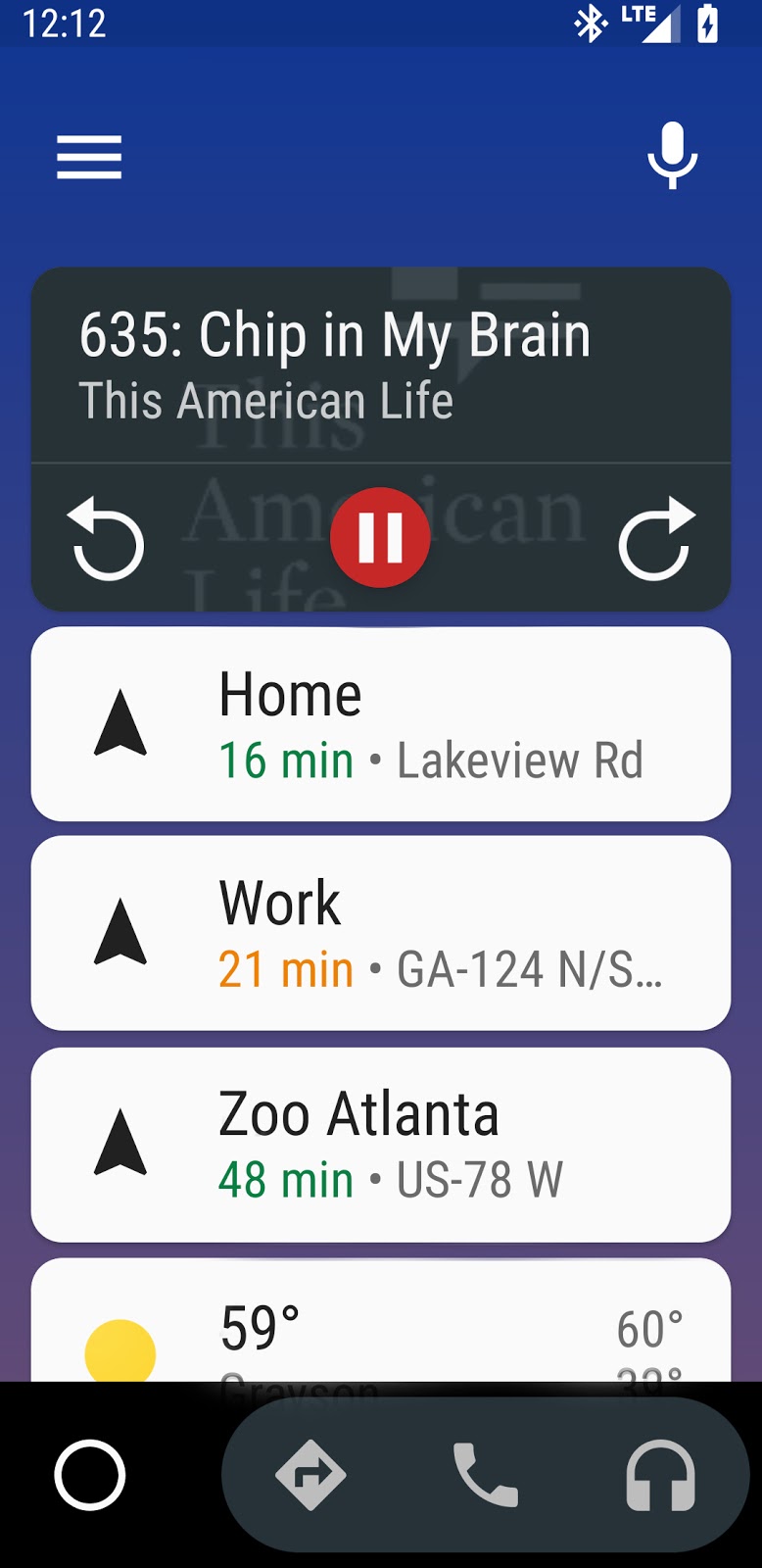
My Phone Wants to go to the Zoo!


My phone wants me to take it someplace fun again.

I used to joke to Anna, back in the pre-pandemic days, that my phone wants to go somewhere interesting--Rock City, Book Nook, the zoo.

See, when I drive (with my phone securely in a phone holder attached to the dashboard, of course) I use Android Auto, which, among other things, displays Navigate guesses/suggestions for places it thinks you might be going, based, I suppose, on where you are, where you often go, your recent Google Maps activity, and (I'm going to say but don't actually believe) where it wants to go. (If you tap on one of these guesses/suggestions, Android Auto gives you step-by-step directions to that place...but you probably figured that out already, didn't you?)

It used to regularly include in its Navigate guesses/suggestions some of the cool places I have saved in my Google Maps profile--bookstores, parks, various kinds of attractions; it was like my phone was saying, "Hey, I know...let's go to Rock City! Wouldn't that be fun?" (Even when I was only going the three miles to the grocery store it would make these suggestions. It was kind of sad, really.)

But a while back it stopped. My phone, apparently, was resigned to sheltering-in-place/quarantining/staying close to home for a while. For a long time, its Navigate guesses/suggestions included only the mundane places I routinely go: Work, Kroger, Home.

But now my phone apparently wants to go out to fun places again. Several times in the last month it has included Zoo Atlanta in its list of Navigate guesses/suggestions.

It's a good idea. Maybe I'll take it there soon.

Thursday, March 4, 2021

What I Haven't Read

I still haven't read The Moviegoer or The Brothers Karamazov or White Noise or The Sound and the Fury or Mickelsson's Ghosts or any of those other books that, back around 1985 or 1986, I decided--was told, got the impression--that I ought to read. I still feel, all these years later, a little guilty, a little embarrassed, for never having read them--though I've started all of them more than once, and I still have copies of some of them.

Why should I feel guilty? Whose condescension and judgement makes me feel embarrassed?

(The correct answers, I know, are "I shouldn't" and "Nobody's." Knowing the correct answers doesn't help.)

For some people--people like me, at least--this is one of the downsides of being a book-loving person and going to college and majoring in English, and especially of going to graduate school in English: the feeling of not having read the right things, of not having read what your professors, your colleagues, the writers you admire, the people who work at Barnes and Noble, all think you should have read.

I've read a dozen of Vonnegut's novels and several by Nabakov. I've read The World According to Garp, and The Ballad of the Sad CafĂ©, and Wise Blood and all of O'Connor's short stories. Most of John Cheever's stories, and lots of Eudora Welty's stories (but none of Cheever's or Welty's novels). For a while I had both "The Love Song of J. Alfred Prufrock" and "The Second Coming" memorized (but at this point I've probably forgotten as much as I remember). I've read If On a Winter's Night a Traveler, and We Have Always Lived in the Castle, and I've read Zen and the Art of Motorcycle Maintenance five or six times.

But it's the books I haven't read that I think about the most. I know that's a defect in my thinking. I'm trying to get over it.

I know there are book-type people, people with degrees in English and even with jobs teaching English in colleges, who don't have this feeling of embarrassment, of anxiety about what they think they ought to have read but haven't. I envy them; I want to know what their secret is. I also rather suspect they're lying.

And I still think I ought to read The Brothers Karamazov.

Thursday, February 25, 2021

Alfred Hitchcock Mystery/Horror Anthologies

Last week I wrote about the Alfred Hitchcock and the Three Investigators series, but there were some other books, released around the same time, that were also important to me, and which had a lot in common with the Three Investigators books. These also had Alfred Hitchcock's name on them and his likeness on the cover (and in some of the internal illustrations), though Hitchcock actually had nothing to do with them; many of them were edited by Robert Arthur, creator of the Three Investigators and author of the first nine books in the series; and they were published by Random House for the young reading audience.

Alfred Hitchcock's Ghostly Gallery and Alfred Hitchcock's Haunted Houseful (and several others, including Sinister Spies, Daring Detectives, and Monster Museum--all with Alfred Hitchcock's before the title proper) weren't novels, they were short story collections, and included stories by many of the greats of the mystery and horror fields, such as Arthur Conan Doyle, H.G. Wells, H.P. Lovecraft, Lord Dunsany, Algernon Blackwood, Theodore Sturgeon, Ray Bradbury, Manly Wade Wellman, and many others. As I've already said, many of them were edited by Robert Arthur ("The editor [presumably a reference to Hitchcock] gratefully acknowledges the invaluable assistance of Robert Arthur in the preparation of this volume" says Alfred Hitchcock's Ghostly Gallery at the beginning of the copyright section, though Alfred Hitchcock's Haunted Houseful acknowledges Muriel Fuller), and Arthur often included a story of his own in the Table of Contents--and his stories were very good; Random House also published an excellent collections of Arthur's stories(Mystery and More Mystery, which has no mention of Alfred Hitchcock on it, but is otherwise much like the above mentioned anthologies).

These are really great books, and I'm glad I had them when I was a kid--though, honestly, the cover (actually more the back cover than the front) of Alfred Hitchcock's Ghostly Gallery (which I got as a birthday or Christmas present when I was about eight; I got the whole book as a present, I mean, not just the cover) scared the bejeebers out of me when I was young. Many of the stories are great, but so are the illustrations.

Thursday, February 18, 2021

The Three Investigators

These are the books that made me fall in love with reading and books, forty-five years ago.

When I say that, I mean that these are literally the books--these actual copies--that I started reading in 1975, thanks to my cousin Sharon (who, I am very sorry to say, is no longer here with us for me to thank for starting me off in this direction), and which I collected and read and re-read voraciously for several years, and which I've had as an important part of my personal library for nearly half a century.

The series--Alfred Hitchcock and the Three Investigators--was created by Robert Arthur in 1964; he wrote the first nine books, and also the eleventh, and when he died in 1969, the series was continued by various other writers for almost two decades more, ultimately reaching forty-three volumes. (It's actually a little more complicated than that, but that's enough of an explanation for this post.) Alfred Hitchcock didn't really have anything to do with the series, he just allowed his name and likeness to be used in the books. The Hitchcock introductions to the books were in truth written by the books' authors, and when Hitchcock died in 1980, the series switched from the real (but no longer living) Hitchcock to the fictional mystery novelist Hector Sebastian. Gradually, all of the original series was revised and republished to feature Sebastian instead of Hitchcock.

The first sixteen books included great illustrations by Harry Kane; those illustrations are an important part of what made me love the books. I'm still disappointed that more novels don't feature illustrations every thirty or forty pages to show you what everything looks like. (Frankly, The Brothers Karamazov could do with a few. If it had some illustrations, maybe I could actually finish the darn thing. Or at least get past page 75. But I digress...)

I've re-read these books--especially the ones by Robert Arthur--a number of times over the years. They hold up pretty well. Nothing's as mind-blowing as being an eight-year-old and discovering them for the first time, but they're still pretty fun.