Thursday, May 6, 2021

Audio Books

There are some books I claim to have read—several by Bill Bryson; pretty much everything I say I've read by David Sedaris; Daniel Pinkwater's brilliant The Snarkout Boys and the Avocado of Death—but really haven't, at least not strictly speaking. Because I listened to them as audio books.

Chances are I've listened to them several times, in fact. I'm sure I've heard Bryson's A Walk in the Woods and Sedaris's Me Talk Pretty One Day five or six times each. Charles Kuralt's Charles Kuralt's America is one of my favorite books; I've listened to it several times, and I've also actually read the printed book—the audio version is abridged, and I wanted to see what I was missing—but I prefer the audio version. It's not that I'm too lazy to read and would rather have Kuralt read his own book to me, it's just that he does it so well.

Many years ago, when I had a regular corporate job and a daily commute, I listened to a lot more audio books than I do these days. There were a lot of really good productions of middle-reader and young adult novels of the kind I then aspired to write, some of which I still have. Because they are mostly on cassettes, it's a lot harder to listen to them now, but someday when I have more time and more energy, I'm going to digitize them to make it easy to hear them whenever I want.

(Why the four books in the picture, you may be wondering, when I didn't name any of them specifically in this post? Well, for one thing they are all books I remember enjoying very much. The Madeleine L'Engle book, A Wind In The Door, which came second in the sequence that began with A Wrinkle in Time, is perhaps my favorite of her books (though I would actually rather read it than listen to it; I think I only listened to this audio book once). The Neil Shusterman book, The Dark Side of Nowhere, is one of the things Anna and I listened to on the drive home from our honeymoon, so I have very fond memories of it. But most importantly, they were in a cabinet in my office and were easily accessible; I didn't have to root around in the garage or that funky storage space under the stairs to find them.)
Thursday, April 22, 2021

My Anxieties Have Anxieties

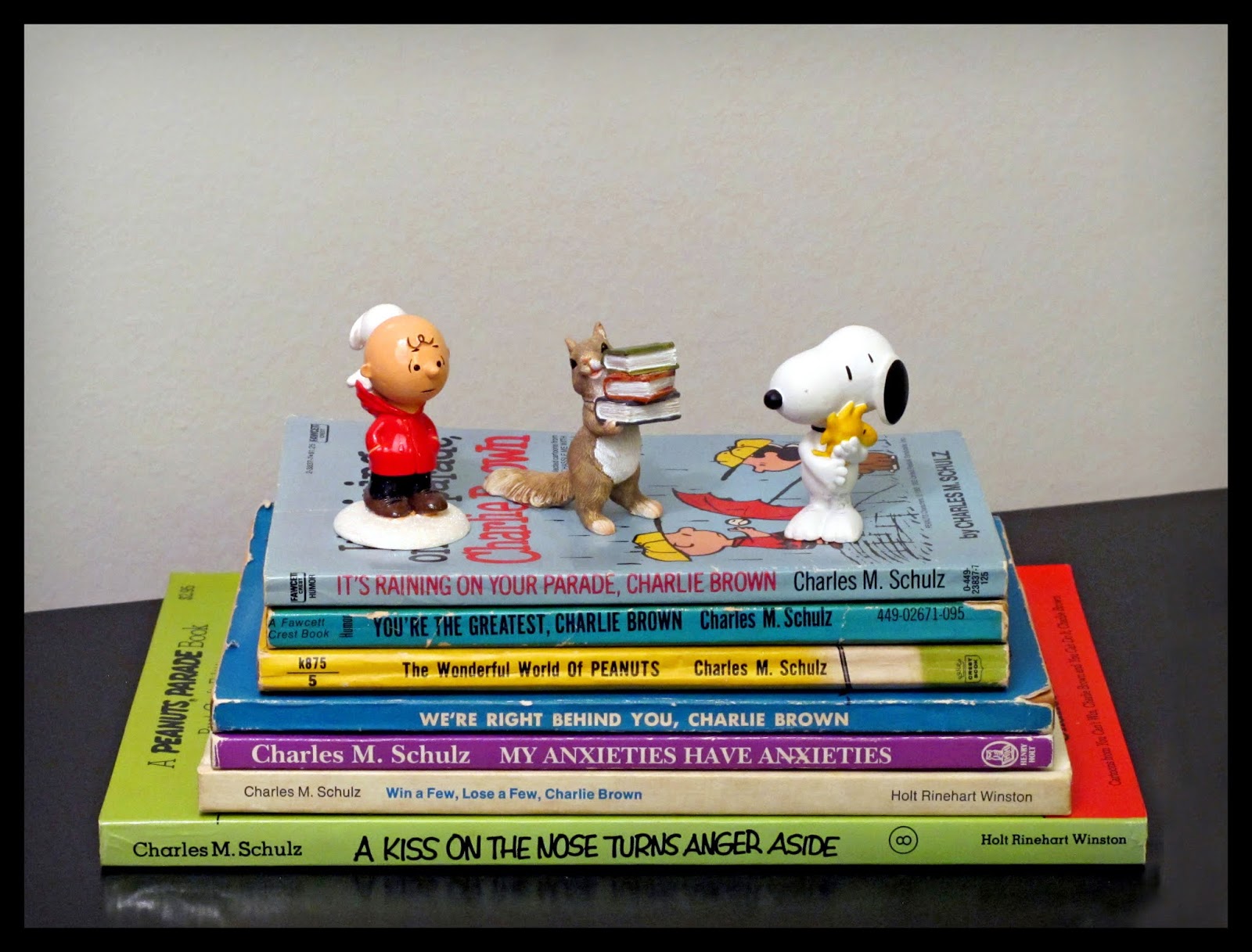
I don't know how old I was when I first read Peanuts. I'm pretty sure it was sometime back in fourth grade, maybe even third, when I started my relationship with these books.

And for me, Peanuts was always about books. I'm sure that for years I was not even aware it was a daily comic strip, probably didn't even know what that meant—but I knew the books. "A Charlie Brown Christmas" was on TV for the first time two years before I was born and had become a seasonal staple by the time I was in fourth grade, but I don't remember seeing it when I was a kid, or seeing any of the other Peanuts TV specials that had been produced by the time I was in fourth grade—but I knew the books.

I've been collecting them, the books, for more than forty-five years. I don't actually have that many—forty-two: I just turned around and counted them—but they are precious to me.

Not everyone cared for Peanuts as much as I do, of course. Al Capp, creator of the "Li'l Abner" comic strip and a generation older than Peanuts creator Charles Schulz, once famously characterized the kids in Peanuts as "...mean little b*stards. Eager to hurt each other." Maybe Capp had a point, but he didn't seem to appreciate the fact that this made them all the more real as kids and as human beings, and that it made the moments of truth and beauty they revealed, either by transcending the inherent melancholy of life or by accepting it, all the more beautiful.

"Life is rarely one way, Charlie Brown," Linus says to his friend as the two lean against the brick wall where they do all their philosophizing, "You win a few, and you lose a few."

"Really?" says Charlie Brown, who—at least in his own perception—has never won a thing in his life, and—again, at least in his own perception—probably never will. "Gee," he says in the last panel, his mouth in the beginnings of a hopeful smile, "that'd be neat!!"

That hopeful smile makes Peanuts wonderful.

Thursday, April 1, 2021

Books I Have Lost

Not everyone who loves to read values books as physical objects; plenty of people love reading but don't need, or even want, to be surrounded by bookcases filled with books.

But I do. I value books as physical objects, and I want, maybe even need, to be surrounded by bookcases filled with books. It makes me happy.

And it really bothers me when I lose a book. Three years ago when we moved into our current house, I had boxes and boxes of books to move and unpack, and at some point--several months, actually--after I was done, I realized there were some books I couldn't find. It's possible I got rid of those books in a fit of downsizing, but I doubt it--the books in question I don’t think I would ever have wanted to get rid of, and one of them, Thomas Merton's The Seven Storey Mountain, is a book I did get rid of once, and then bought another copy of some months later when I found that I wanted it back. I'm afraid that somehow amidst all the hubbub of our move I lost or misplaced a whole box. (And what else may have been in that box that I haven't missed yet?)

Whenever I get rid of books I regret it. Oh, I don't miss every single book I've ever gotten rid of, but I'm never sure which books I'll miss and want back. About twenty-five years ago I read The Magus by John Fowles; it was brilliant and compelling, but also long and challenging, so at some point I got rid of it. I wish I hadn't. I doubt I'd re-read the whole thing again--though I might--but it would mean something to me to have it on my shelves. I also used to have a great hardback Modern Library edition of Emerson's essays, but I got rid of it because Emerson's work has long been in the public domain and is readily available online if I want to read it on my tablet, and the book was taking up valuable shelf space...

The next time I get the idea to purge some of my books, I'm going to box them up and put them in the attic instead of getting rid of them. That will make it easier to get them back three months later when I decide I do want them after all, and will give me the pleasure of going through the box and finding some things I'd forgotten about.

Thursday, March 25, 2021

Lots of Short Stories


I love short stories. As I've written before, it's my favorite literary form, and there are Great and Important writers--Anton Chekhov, Raymond Carver, Grace Paley--whose published prose writing consists entirely of short stories (though Chekhov also wrote plays, of course, and Carver and Paley both wrote poetry), and other writers who did write novels but are remembered primarily for their short fiction: Eudora Welty, Isaac Bashevis Singer, John Cheever.

I've never managed to finish Moby-Dick, though I've started it several times and gotten about half-way through, but I've read "Bartelby" more than once and I love it. (I think I may have written a paper on it when I was an undergraduate, but I have no idea what I said; probably a bunch of that annoying claptrap that I was so full of in my late teens and early twenties. If you knew me back then: Man, I'm really sorry. I'm better now. I really hope so, anyway.)

Don't get me wrong: I do like novels. I used to read a lot of them. I often wish I read more of them these days. I really wish I could read more novels--but I'm kind of a slow reader, and frankly I can't often sustain interest for that long anymore in one story, in one plot. Usually after half an hour or forty-five minutes, maybe an hour, I'm ready to move on to something else.

Which is why the short story is perfect for me.

Thursday, March 18, 2021

Not Fiction

When I was a kid, reading to me meant specifically fiction. If it wasn't a novel, I didn't really think of it as "reading."

But I realize now that I read a lot of non-fiction back then. The earliest non-fiction memory that I can hang a book title on, and which is also one of my most pleasant library memories, is of Edward Edelson's Great Monsters of the Movies, which came out in 1973 but which the Bethesda library didn't get until I was in third grade in 1975. The librarian--whose name I wish I could remember--set it aside for me when it arrived and gave me the honor of being first to check it out. She knew I would love it. She was so right!

The Bethesda library also had this great book about reptiles that I kept checked out nearly constantly in fourth and fifth grade, and I read books about dinosaurs, and the Loch Ness monster and Bigfoot (some books about one or the other, some books that included both), and various supernatural goings-on (C.B. Colby's Strangely Enough! being one I remember well; I have two copies of it now). When I got older, I read books about lasers and music and other things that interested me, and when I began to get seriously involved in science fiction, I read through the Berkmar library's copy of Peter Nicholls's The Science Fiction Encyclopedia (the original edition, from 1979) every chance I got. I eventually found my own copy of it at Book Nook, but it’s missing that cool dust jacket.

For the last decade or so, I haven't read many novels, but I've read a lot of non-fiction, especially short works, mostly feature stories and personal essays; I'd now say it's my second favorite literary form (after the short story). Gay Talese, Gene Weingarten, Michael Paterniti, Malcolm Gladwell, John Jeremiah Sullivan, and Hampton Sides have all published fantastic collections of their magazine pieces, and there are also personal essays I love by the likes of Bailey White and the great E.B. White (no relation to Bailey White that I'm aware of; in fact, I just realized in typing this that they have the same last name!).

I now most definitely think of non-fiction as reading.

Thursday, March 11, 2021

The Weekly Reader Book Club

Back in fourth grade I was a member of the Weekly Reader Book Club.

Man, it was the best getting books in the mail! And I read every one of them, always finishing one week's book before the next week's arrived. Over the course of the next couple of years I read them all again, getting through some of them three or four times while I was still in elementary school. (This was, of course, in addition to re-reading Harriet The Spy and The Witch of Blackbird Pond every couple of months, and reading other books from the school library as well, like The Ghost Belonged to Me and Tuck Everlasting. I was constantly reading back then. It's a wonder I managed to fit in any of my actual school work!) I still have all of those Weekly Reader Book Club editions, on a bookshelf in my bedroom.

But it's not that many, really: only seven--all of the ones I own are shown in the photograph--so if it really was "weekly," then I wasn't even in it for two full months. I'm not sure why it was such a short time; maybe it was even my choice. Maybe I begged my parents to let me divert the money towards the ever-growing Micronauts and Shogun Warriors collection my brother and I were intent on amassing. (Hmmm...Micronauts vs. books? That's a hard call. Today, I'd probably pick books--probably--but I'm not so sure about 1978 Chris.) It was a long time ago, and I don't remember. I know that the Weekly Reader Book Club started many years before they ever sent me a book, and I also know it doesn't exist any more. But then, neither do Micronauts or Shogun Warriors.

And by the way, Harriet the Spy (by Louise Fitzhugh), The Witch of Blackbird Pond (by Elizabeth George Speare), The Ghost Belonged to Me (by Richard Peck), and Tuck Everlasting (by Natalie Babbitt) are still great books--I've re-read them all in the past few years, and they hold up well. If you haven't read them and you're interested in children's literature, I recommend them. You might enjoy them.

Wednesday, March 10, 2021

My Phone Wants to go to the Zoo!


My phone wants me to take it someplace fun again.

I used to joke to Anna, back in the pre-pandemic days, that my phone wants to go somewhere interesting--Rock City, Book Nook, the zoo.

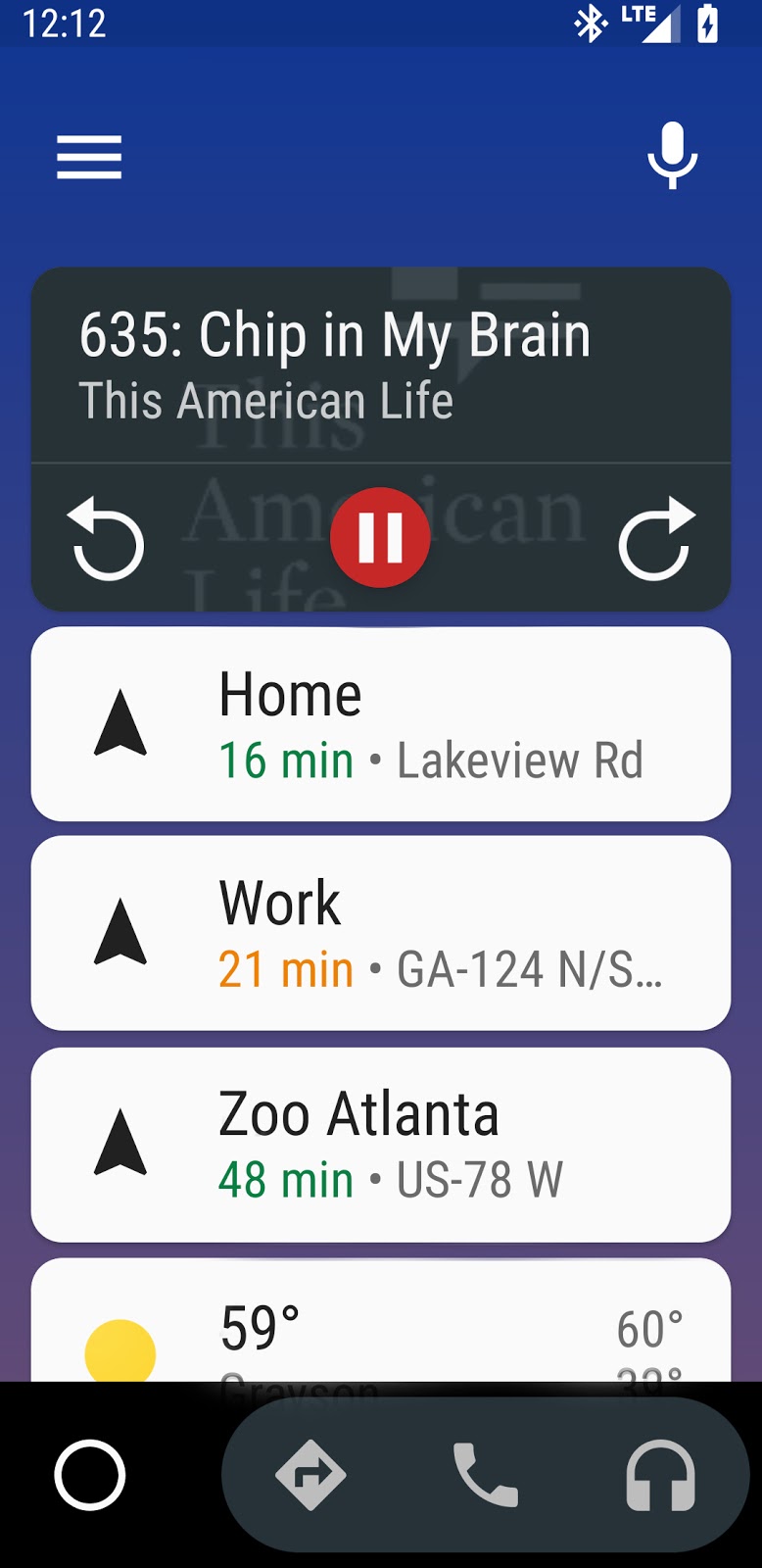
See, when I drive (with my phone securely in a phone holder attached to the dashboard, of course) I use Android Auto, which, among other things, displays Navigate guesses/suggestions for places it thinks you might be going, based, I suppose, on where you are, where you often go, your recent Google Maps activity, and (I'm going to say but don't actually believe) where it wants to go. (If you tap on one of these guesses/suggestions, Android Auto gives you step-by-step directions to that place...but you probably figured that out already, didn't you?)

It used to regularly include in its Navigate guesses/suggestions some of the cool places I have saved in my Google Maps profile--bookstores, parks, various kinds of attractions; it was like my phone was saying, "Hey, I know...let's go to Rock City! Wouldn't that be fun?" (Even when I was only going the three miles to the grocery store it would make these suggestions. It was kind of sad, really.)

But a while back it stopped. My phone, apparently, was resigned to sheltering-in-place/quarantining/staying close to home for a while. For a long time, its Navigate guesses/suggestions included only the mundane places I routinely go: Work, Kroger, Home.

But now my phone apparently wants to go out to fun places again. Several times in the last month it has included Zoo Atlanta in its list of Navigate guesses/suggestions.

It's a good idea. Maybe I'll take it there soon.